
The Indian and Chinese armies have been locked in a bitter standoff at multiple locations in eastern Ladakh for over eight weeks since May 5.

'The separatist resurgence in Balochistan is thwarting Pakistan's plans to build CPEC projects to optimally utilise Balochistan's energy reserves,' points out Brigadier Gurmeet Kanwal (retd).

There is growing acceptance of the idea in the international community that engaging the Taliban government is a far better approach than ostracising it, observes Ambassador M K Bhadrakumar.

'If we play our cards right, we may even benefit from the competition between the US and China as seen from increased investment from each of these countries into India.' 'The size of our market gives us an important lever of power which we shall have to play adroitly and intelligently,' points out Ambassador Gautam Bambawale -- who served as India's envoy to China -- in the Professor V M Dandekar Memorial Lecture 2019, delivered on March 8, 2019 in Pune.

A new book reproduces original Chinese maps that contradict Chinese propaganda. The book reveals Chinese intelligence admissions that Beijing never maintained any army base, customs office or other government function in the disputed area until 1983.

It is the first-ever visit by a head of the Indian Army to South Korea.

India cannot choose its geography and devise regional strategies to dovetail into the Western Indian Ocean hypothesis conceived in the Pentagon, argues Ambassador M K Bhadrakumar.

By changing the nation's name from India to Bharat, would this landmass overnight lose the emotional and cultural linkage that had been built over generations, centuries and millennia, asks N Sathiya Moorthy.

There is a congruence of interests between Ukrainian intelligence and its Western mentors to destroy Wagner and eliminate it from the geopolitical chessboard altogether, argues Ambassador M K Bhadrakumar.

A confrontation with the Taliban in Kabul in this fading light of a twilight zone would have been sheer madness, observes Ambassador M K Bhadrakumar.
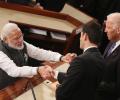
The maiden bilateral meeting between President Joe Biden and Prime Minister Narendra Modi on Friday will further strengthen the US-India strategic ties and allow the leaders to discuss the situation in Afghanistan and how the two countries can work together to fight terrorism, a senior White House official has said.
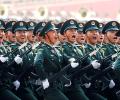
Currently, the reserve forces are under the dual leadership of military organs and local Communist Party committees and they would be brought under the control of the ruling party and the CMC from July 1, the state-run Xinhua news agency reported.
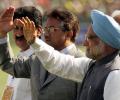
Manmohan Singh and Musharraf felt that what they were embarking upon, if successful, could lead to a future of boundless potential for the two countries and for the relationship that was hard to foresee from the prism of the existing situation and the historical position and orthodox ideas on both sides.

The Taliban knows that Washington holds the key, points out Ambassador M K Bhadrakumar.

"Any attempt to endanger national sovereignty and security, challenge the power of the central government and the authority of the Basic Law of the HKSAR (Hong Kong Special Administration Region) or use Hong Kong to carry out infiltration and sabotage activities against the mainland is an act that crosses the red line, and is absolutely impermissible," Xi said.

Beijing wants assurance that its investments won't come under scrutiny

'The big power struggle in faraway Europe erupted at a most critical juncture when India has been increasingly sceptical about American policies and statesmanship,' argues Ambassador M K Bhadrakumar.

The ecosystems of India and China today jostle against one another across Asia and much of the world.
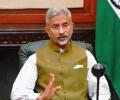
External Affairs Minister S Jaishankar will arrive in New York on Sunday to participate in the high-level 77th session of the UN General Assembly, which kicks off on September 20 with the opening of the general debate.

There is no better way to address the security threat emanating from ISIS and other terrorist groups in Afghanistan than by co-opting the Taliban, asserts Ambassador M K Bhadrakumar.
China's state-run media said that the leadership of the two countries successfully solved the Doklam standoff in 2017 with 'concerted efforts and wisdom'.

For months, Hong Kong's streets have seethed with discontent. Scenes show protesters, sometimes numbering in the hundreds of thousands, many wearing surgical masks and carrying umbrellas that have come to signify resistance. The images are astonishing, and the issues that set the protests in motion are complex. Amid these 11 weeks of protests, here's how daily life unfolds.

Top security czars of India, Russia, Iran and five central Asian countries on Wednesday pledged to work for ensuring that Afghanistan does not become a safe haven for global terrorism and called for the formation of an open and truly inclusive government in Kabul.

'Tibet remains a prickly issue between the giant Asian nations. China still claims more than 80,000 sq kilometres of Indian territory in the Northeast. Why? Just because Beijing refuses to acknowledge the McMahon line which separates India and Tibet, and this, simply because the 1914 Agreement delineating the border was signed by the then government of independent Tibet with India's then foreign secretary (Sir Henry McMahon),' says Claude Arpi.
The first priority for the new Tibetan administration in Dharamsala should be to look at Tibetan recruitment in the PLA, suggests Claude Arpi.

The reduction of tension on the Chinese border may have reduced the urgency of a Biden-Modi meeting, but the sooner Modi starts a bromance with Biden the better as he had done with Obama and Trump, suggests Ambassador T P Sreenivasan.

The dinner Jill Biden and her husband US President Joe Biden hosted for Indian prime minister Narendra Modi, June 22, at the White House brought together, Indians and Americans from so many firmaments.

"Fifteen years ago, I was leading the efforts to approve the historic civil nuclear deal with India. I said that if the US and India became closer friends and partners, then the world will be a safer place," Biden, who was vice-president in the Obama administration, said while addressing the Indian-American community on India's Independence Day.
"I've spoken with Foreign (External Affairs) Minister (S) Jaishankar a number of times about this (Chinese aggressive actions). The Chinese took incredibly aggressive actions. The Indians have done their best to respond to that," Pompeo told reporters at a news conference in Washington, DC.

The people who know Tibet will continue to fight the good fight. Long, hard, less than hopeful, but always peaceful.
India's national security strategy needs to be revised periodically since the global and regional geopolitical situation is dynamic, points out Commodore Venugopal Menon (retd).

At a time when China is trying to make its foray into South Asia, India should use its shared history to strengthen its ties in the region, says Dr Rup Narayan Das.
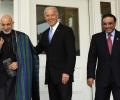
US-Pakistan relations are poised to touch a qualitatively new level under the Biden administration, notes Ambassador M K Bhadrakumar.

It is the first visit abroad by a senior Union minister in four months as foreign travels were restricted in view of the coronavirus pandemic.
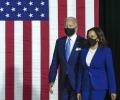
US President-elect Joe Biden plans to increase the number of high-skilled visas, including H-1B, and eliminate the limit on employment-based visas by country, both of which are expected to benefit tens of thousands of Indian professionals impacted by some immigration policies of the outgoing Trump administration.

Blinken and Indian leaders on Wednesday will discuss a plethora of pressing issues such as the fluid situation in Afghanistan, regional security concerns, COVID-19 response and ways to boost Indo-Pacific engagement, people familiar with the agenda of talks said.
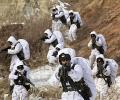
In all the noise surrounding the Dok La confrontation, Claude Arpi focuses on a crucial issue that has hardly been covered -- the construction of roads for the armed forces and the local population to reach the most remote border posts.
Pompeo will travel to India, Sri Lanka, Japan and South Korea from June 24 to 30. His four-nation is aimed at deepening US partnerships in the strategic Indo-Pacific region.

Shehbaz, the younger brother of former three-time prime minister Nawaz Sharif, received 174 votes -- two more than the simple majority of 172.

But why should India be talking to the Taliban in the first place? There is no love lost there. India will never forget or forgive the humiliation to which the Taliban subjected it in the IC-814 hijack, notes Shekhar Gupta.
